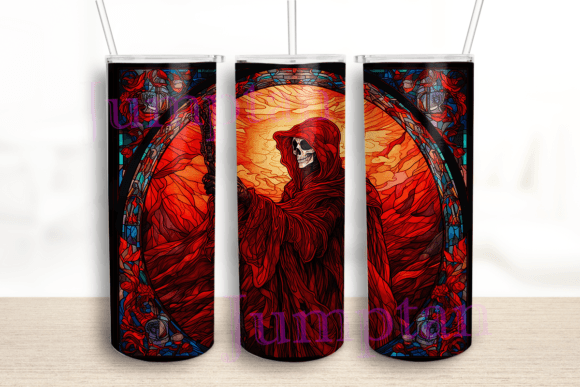
Stained Glass Red the Grim Tumbler: Graphics for Crafts
As a digital product creator who’s launched over 200 Etsy listings and scaled print-on-demand collections across Shopify and Creative Fabrica, I opened Stained Glass Red the Grim Tumbler with one question: “Does this asset earn its place in a commercial-ready product lineup?” Not just as decoration—but as functional, scalable, audience-aligned design.
First impression? It lands with quiet confidence. The stained glass aesthetic—crisp lead lines, rich reds, subtle translucency—feels both vintage and contemporary. It leans into gothic charm without tipping into macabre; it’s bold but not aggressive, decorative but not fussy. This isn’t playful kawaii or minimalist Scandinavian—it’s niche-specific: ideal for Halloween-adjacent shops, goth-curious stationery brands, witchy planners, boutique coffee merch, and indie gift sellers targeting adults who appreciate craftsmanship and mood-driven visuals. Think “elegant eerie,” not “cartoon spooky.”
The WHAT YOU RECEIVE is straightforward: a single ZIP file with two high-resolution PNGs at 300 DPI—both sized 9.3” x 8.2”, one straight-edged, one tapered. That taper matters. It’s built for tumbler wraps, yes—but also for curved Canva templates, mug mockups, and sublimation blanks where edge conformity boosts realism. No SVG, no layered PSD, no vector variants—but that’s fine if your workflow prioritizes fast integration over deep editing.
Here’s where Stained Glass Red the Grim Tumbler shines in real selling scenarios:
- Printable design for wall art bundles—especially when paired with velvet-textured backgrounds or parchment-style frames in Canva templates.
- Tumbler wrap and mug design assets for POD platforms like Printify or Gelato—no clipping mask needed thanks to clean transparency.
- Cricut project base for vinyl decals (test cut lines first—lead outlines are sharp but narrow).
- Greeting card or invitation template focal point—works especially well with serif fonts (e.g., Playfair Display) for contrast and gravitas.
- Digital download inclusion in seasonal design bundles (e.g., “October Mood Pack” or “Gothic Home Decor Kit”).
- Social media graphics for small business branding—used as a watermark, story highlight icon, or banner accent to reinforce visual hierarchy.
- Sticker design for planner kits—though avoid scaling below 2.5” to preserve line clarity.
For product presentation, this graphic lifts perceived value instantly. On an Etsy thumbnail, its strong contrast and centered composition draw attention even at small sizes. In mockup previews—especially on matte ceramic tumblers or linen tote bags—it reads as premium, handmade, intentional. That matters for click-through rates and conversion. When bundled with coordinating patterns (think charcoal herringbone or black lace textures), it builds cohesive brand identity without needing custom illustration.
Where does it work best? Large-format printable products, themed digital bundles, tumbler-focused listings, and social-first promos. Its color depth and transparency make it versatile across light and dark backgrounds—just verify how the red renders on your target substrate (some sublimation printers mute deep reds).
Use carefully in these situations:
- Tiny sticker details: Fine lead lines may blur or vanish under 1.8” scale.
- Text-heavy templates: Its visual weight competes with body copy—best as a header or focal graphic, not background filler.
- Low-resolution print products: Avoid using it for 72 DPI web banners or email headers—it’s built for physical output and high-fidelity digital use.
- Dark backgrounds with low contrast: Test against charcoal, navy, or black—some screen calibrations mute the stained glass glow.
- Cricut/Silhouette projects requiring precise cut paths: Since only PNGs are included, you’ll need to trace or convert manually—check edge smoothness before mass production.
Practical seller notes I applied before listing:
- Previewed both PNGs on white and dark mockups—confirmed transparency holds cleanly.
- Test-printed on matte photo paper and sublimation blank—verified red saturation and lead-line definition.
- Loaded into Canva and resized across mobile and desktop templates—no pixelation, no bleed issues.
- Checked licensing: confirmed commercial license allows finished goods (e.g., printed mugs, stickers, digital templates) with no attribution required.
- Paired with four font families: serif (for elegance), sans serif (for modern contrast), script (for invitation warmth), and display (for headline impact)—all held visual balance.
- Organized customer files clearly: “RedGrim_Straight.png” / “RedGrim_Tapered.png” — no ambiguous naming.
This isn’t a jack-of-all-trades graphic design asset. It’s a focused, mood-driven commercial design that serves specific audiences and product types exceptionally well. If your shop leans into gothic, artisanal, or seasonal aesthetics—and you’re building printable design, SVG products, or tumbler-centric merchandise—Stained Glass Red the Grim Tumbler earns its spot. But don’t drop it into every bundle blindly. Use it intentionally: as a signature piece in a curated collection, not filler in a generic clipart pack.
For creative marketplace sellers, it’s a reminder that strong niche alignment often outperforms broad appeal. One well-executed, audience-resonant illustration can anchor an entire product line—especially when backed by clean files, clear licensing, and thoughtful application. That’s how small business branding gains traction. That’s how handmade business becomes scalable business.